

5kW Solar System Pakistan 2026 – Price, Units, Load & ROI

A 5kW rooftop solar system is the sweet spot for many Pakistani households: large enough to cover most daytime loads for a medium family, compact enough to fit on a typical roof, and—right now—one of the fastest ways to lock in predictable electricity costs. Below I give you a practical, numbers-first guide that uses recent Pakistan market data (2024–2025/early-2026), covers price breakdowns, expected generation (units), load-matching tips, realistic ROI/payback calculations, and the risks/solutions you need to plan for. Every key claim is backed by Pakistani sources so you can rely on the figures when advising clients, writing proposals, or deciding for your own home.
Quick summary
- Typical turnkey 5kW grid-tie (net-metering eligible) system in Pakistan in the 2025–2026 market ranges roughly ₨400,000 – ₨850,000 depending on panel and inverter brand, battery inclusion (if any), and installation quality.
- Expected real-world production: ~20.6 kWh/day → ~7,528 kWh/year (using a conservative 5.5 kWh/m²/day average insolation and typical system losses).
- Using an average household electricity rate ~₨34.47 / kWh (government-reported 2025 revision example), annual bill offset can be around ₨259,500/year — leading to a simple payback of ~1.5–3.3 years depending on upfront price.
1) Real pricing — component-level and turnkey ranges
Panel cost — modern A-grade panels (Longi, Jinko, Canadian, etc.) in Pakistan have wholesale retail prices roughly ₨33–₨39 per watt for mainstream 2024–2025 modules, depending on watt class and supply. For 5,000 W this implies panel-only cost ~₨165,000–₨195,000.
Inverter (grid-tie string / hybrid) — a reliable 5 kW string inverter or hybrid inverter (if you want future battery backup) typically runs between ₨70,000 – ₨250,000 depending on brand (Good quality Chinese brands or international brands). Cheap inverters reduce upfront cost but shorten life and raise replacement risk.
Balance of System (BOS) — mounting frames, cabling, AC combiner, earthing, isolation switch, DC protection, firmware/setup, and labour: ₨50,000 – ₨150,000 depending on roof complexity.
Batteries (optional) — if you add lithium backup (4–8 kWh usable), add ₨200,000 – ₨700,000 depending on chemistry and warranty. Most net-metered rooftop owners avoid batteries for daytime bill savings and add batteries only for blackout resilience.
Turnkey examples from Pakistani vendors show a wide spread because some offers are panel-only while others include premium inverters and full installation. Public listings and dealers in Pakistan show turnkey 5kW packages from ≈₨400,000 up to ≈₨850,000. Always check what is included (warranty, civil works, wiring, commissioning).
2) How many units (kWh) will a 5kW system produce in Pakistan?
To forecast energy, use three inputs:
- Peak sun hours (average insolation). Pakistan is solar-rich: studies report ~5–7 kWh/m²/day across the country; a conservative average for many populated regions is ~5.5 kWh/day annually (seasonal variation exists).
- System size: 5.0 kW (nameplate DC).
- System performance ratio (losses): real losses from temperature, soiling, wiring, inverter efficiency, shading — use ~0.75 (75%) as a conservative performance ratio for rooftop systems.
Calculation (step-by-step): 5kW Solar System Pakistan 2026 – Price, Units, Load & ROI
- Daily energy = 5.0 kW × 5.5 hrs × 0.75 = 20.625 kWh/day.
- Annual energy = 20.625 × 365 = 7,528.125 kWh/year.
Rounded: ≈7,528 kWh/year. This number can be higher in places like southern Punjab in summer (profiles for Rahim Yar Khan show even higher seasonal output) and lower in winter. Use local irradiance maps for precise estimates.
Table of Contents
3) What loads will a 5kW rooftop cover?
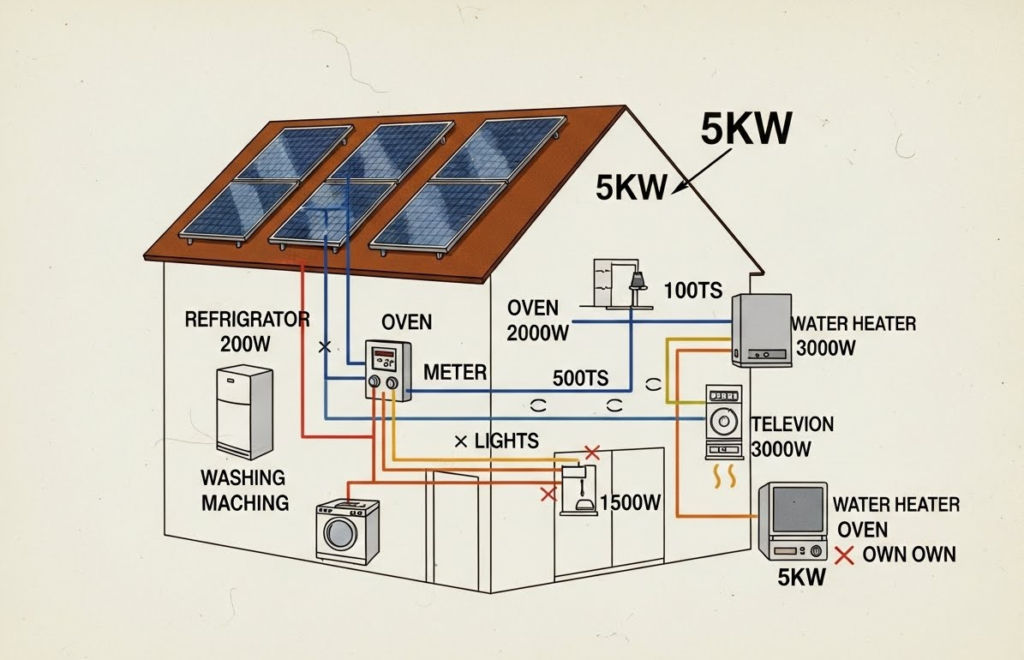
A 5kW system producing ~7,500 kWh/year is enough to offset most daytime loads for a medium household and significantly reduce monthly bills:
Example monthly breakdown (approx):
- Monthly production ≈ 7,528 / 12 ≈ 627 kWh/month.
- Common loads that sum to ~600–700 kWh/month: split AC use for few hours/day (1–2 split ACs), fridge, lights, LED TV, fans, washing machine, occasional water heating (if electrified), and daytime EV/EV charger top-ups.
Important: rooftop solar offsets daytime, not necessarily nighttime loads unless you have battery backup or net-metering that credits exported energy. Match critical daytime loads (fridge, water pump, kitchen appliances, fans, TVs) to solar hours for best benefit.
4) Monetary savings and ROI — concrete calculations
Using the annual production above (7,528 kWh/year) and a representative electricity price:
Representative grid price: the April–July 2025 tariff revision and recent government statements indicate domestic average rates in the mid-₨30s per kWh (example: government announcement ~₨34.47/kWh in 2025 for domestic users). Use your local DISCO tariff to refine.
Annual savings (example):
- Annual generation × tariff = 7,528.125 kWh × ₨34.47/kWh = ₨259,494.47/year (rounded ≈ ₨259,500/year).
Simple payback (examples for three price points):
- If system cost = ₨400,000 → payback = 400,000 ÷ 259,494.47 ≈ 1.54 years.
- If system cost = ₨600,000 → payback ≈ 2.31 years.
- If system cost = ₨850,000 → payback ≈ 3.28 years.
(These simple paybacks ignore maintenance, inverter replacement after ~8–12 years, and financing costs.) Calculation details available on request. The short payback reflects Pakistan’s relatively high and volatile electricity tariffs and strong solar resource. Sources: local vendor pricing and government tariff notices.
Note on real ROI 5kW Solar System Pakistan 2026 – Price, Units, Load & ROI: A full ROI model should include:
- System lifetime (panels 25+ years, inverter 8–15 years).
- O&M: cleaning, minor repairs (~₨5–10k/year typical).
- Inverter replacement cost at year 8–12.
- Potential changes in net-metering credits or tariffs (policy risk).
- If financed, loan interest changes payback. After modeling these, a 5kW system still usually yields highly attractive returns in Pakistan.
5) Net-metering & policy risks (must-know for 2025–2026)
Net-metering in Pakistan expanded quickly; however, in 2025 the government began adjusting rules to protect grid economics (press briefings and official notices showed amendments and discussions about reducing payments to surplus exporters and adding import taxes). The Economic Coordination Committee (ECC) approved amendments addressing grid burden (March 13, 2025), and press reporting warns of proposals to reduce net-metering compensation rates and add duties on imports. These policy moves can change the economics for systems sized to export a lot. Hard rule: design for self-consumption first; export as secondary benefit.
Actionable implications:
- If your client expects to rely on selling large surplus to the grid, verify current net-metering rules with the local DISCO and NEPRA before finalizing ROI.
- For households with frequent outages, consider a hybrid inverter (higher upfront cost) and a small battery to make exported energy available at night when grid is down.
6) Technical tips: optimise yield and lifetime
- Panel selection: prefer Tier-1 mono PERC / N-type modules with 25-year linear performance warranty. Price per watt is higher but degradation is lower. (Market leaders: Longi, Jinko, Canadian — local distributors list current prices).
- Inverter sizing: for purely grid-tie systems, a 5 kW inverter is typical. For future battery add-ons, choose a hybrid inverter compatible with chosen battery chemistry.
- Orientation & tilt: tilt equal to latitude or slightly lower for more annual yield in Pakistan; avoid east/west split unless roof shape forces it.
- Soiling & cooling: schedule cleaning 2–4 times/year (depends on dust) and provide good airflow under panels to reduce thermal losses.
- Wiring & protection: use certified DC cabling, surge protection, and earthing. Poor BOS kills warranties faster than panel failures.
- Warranty checks: ask for PID, low-light performance, and LID specs; confirm importer will honor warranty in Pakistan.
7) Common problems & practical solutions
- Policy changes reduce exported credit: reduce system size to prioritize self-consumption or install a battery if you need night backup.
- Low quality installs / early inverter failure: insist on local references, 5–10 year installation warranty, and choose inverters with local service centers.
- Rising panel/inverter prices or customs taxes: buy and install promptly if you have a near-term need, but lock in with reputable vendors and get written scope of supply. Government occasionally adjusts duties—track customs and finance ministry updates.
8) Practical buying checklist (for homeowners / small businesses)
- Request itemised quotation: panels (model & watt), inverter (model & firmware), BOS list, mounting, labour, commissioning, and taxes.
- Check panel datasheet: watt tolerance, degradation (≤0.7%/yr desired), temperature coefficient.
- Verify inverter certificate, anti-islanding, and local service presence.
- Confirm net-metering application assistance by vendor and timeline to get bidirectional meter. (Policy changed in 2025: check local DISCO rules.)
9) Example: Full worked example for a homeowner in Punjab
Assume: 5 kW DC, average insolation 5.5 kWh/day, performance ratio 0.75, tariff ₨34.47/kWh, turnkey cost ₨600,000.
- Annual generation = 7,528 kWh.
- Annual bill offset = 7,528 × 34.47 ≈ ₨259,494.
- Simple payback = 600,000 ÷ 259,494 ≈ 2.31 years. (After payback, the homeowner gets decade(s) of near-free electricity minus modest O&M.)
This example illustrates why, under 2024–2025 market conditions and unless policy changes dramatically, rooftop solar is a compelling investment.
10) Final recommendations — buying & planning checklist
- Get 3 quotes with full BOM and compare on a unit cost per watt and expected annual kWh.
- Ask for a site-specific yield estimate (not a generic claim). Good vendors use shading analysis and tilt to model expected annual kWh.
- Design for self-consumption first. Batteries can be added later if needed; this reduces policy exposure.
- Keep documentation of warranties and installation certificates—these are vital for later claims or resale value.
- Monitor policy & tariff announcements: changes in net-metering calculations or import duties (seen in 2025 policy moves) can shift economics. Verify with NEPRA/DISCO before big procurement decisions.